- Wednesday, 29 July 2026

Two centuries-old statues return to Nepal from US


Kathmandu, July 7: A proud moment for Nepal as two centuries-old statues of cultural and archaeological significance have returned home from New York, marking another victory in the nation’s ongoing mission to reclaim its stolen heritage from countries around the world.
The 13th century bronze Padma Pani was returned from Metropolitan Museum of Arts of Manhattan of New York and 16th century wooden statue of the Goddess of Dance (Nrtyadevi) was returned from Berkley Art Museum of America.
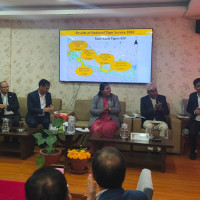
Although the two extraordinary treasures from Nepal’s living heritage arrived in Nepal on June 26, they were officially handed over to the Department of Archaeology (DoA) on Monday during a special ceremony held at the department’s office, such marking another milestone in the nation’s efforts to reclaim its stolen cultural treasures.
Rajendra Maharjan, president of Newa Guthi of New York, Mike Harker, and Public Affairs Chief of US Embassy jointly handed over such treasures to the DoA. The retuned 13th century bronze Padmapani Lokeshwor statue originally belonged to Tham Bahil (Vikramashila Mahavihar, Bhagawan Bahal) of Thamel, Kathmandu and was stolen in decade of 1980. The 16th-century wooden statue of the Goddess of Dance (Nrtyadevi) was stolen from I- Baha Bahi of Lalitpur between 1988 and 1989.
The repatriation has been made possible through the special coordination of the Consulate General and Newa Guthi of New York, with the personal expenses covered by Newa Guthi.
A total of 203 sculptures and art objects of archaeological importance have been returned to Nepal from UK, Austria, America, China (Tibet), India, Germany, Australia and Italy through the efforts of various national and international individuals and organisations.
The number of archaeological objects retuned to Nepal from United States alone has reached 127. Diplomatic initiatives are being taken to return some art objects from countries like America, France, the UK, China, Austria and Australia, said Saubhagya Pradhananga, Director General of DoA.
Mike Harker, Public Affairs Chief of US Embassy said that the United States has reaffirmed its commitment to helping Nepal recovery its stolen cultural heritage following the repatriation of the 13th century gilt bronze Padmapani and the 16th century wooden Padma Pani.
The repatriation as a milestone under the recently signed US-Nepal Cultural Popery Agreement, emphasing that it strengthens efforts to combat illicit antiquities trafficking, protect cultural heritage, uphold the rule of law and deepen bilateral cooperation, he added.
Maharjan said that the campaign to recover Nepal’s stolen cultural artefacts from the United States began in 2014 in coordination with the Consulate General of Nepal in New York.
He further said the repatriation such statues was the result of years of collaboration among Nepali community members, US authorities and heritage advocates.
The statues as living deities rather than mere artworks, emphasising their deep religious and cultural significance to the Newa community.
Sunita Dangol, Acting Mayor of the Kathmandu Metropolitan City, said that the county had regained not only two sacred deities but also a part of its lost history and identity.
She stressed that the repatriation should mark the end of the process, urging authorities to reinstall the idols at their original shrines where they belong and continue to be worshipped.
Protection of cultural heritage is a shared responsibility of government agencies, local communities and citizens, said Dangol.
Chiri Babu Maharjan, Mayor of the Lalitpur Metropolitan City, emphasised that the statues must be reinstated at their original sites with strengthened security measures to prevent future thefts.
Mukunda Prasad Niraula, Secretary of Ministry of Culture, Tourism and Civil Aviation empashised the protecting national heritage is a shared responsibility across all levels of government and society.
Highlighting the importance of institutional coordination, Secretary Niraula said that the returned artefacts should be preserved and reinstalled in accordance with religious and cultural traditions, ensuring their continued spiritual and historical significance.