- Wednesday, 29 July 2026

New Ray Of Hope For Usury Victims

Illegal moneylending has been a severe problem facing many vulnerable people even today in Nepal. The informal lending practice has been widespread in Tarai districts, forcing vulnerable individuals and communities into an exploitative and vicious cycle of poverty. Under this traditional lending system, private lenders charge exorbitant interest rates on loans and use fraudulent documents as transaction deeds. Such loan sharks are found using usury as a means to exploit vulnerable individuals.
Borrowers are bound to opt for this lending system because of a lack of easy access to banking services in their locality. They have to pay back many times more money than they had actually borrowed from their lenders as transaction deeds are always written in favour of lenders. If borrowers are unable to return interest and loan to their lenders within the stipulated timeframe, the latter may seize the former’s land, house, jewelry or other assets that were kept in security for the loan. People are mostly seen taking high-interest loans for spending on their children’s marriage, and sending them abroad for higher education or employment. Medical treatment and increasing cost of living also force them to borrow money.
Justice
Although previous governments also seemed to have taken initiatives to address this issue, they failed to deliver justice to the usury victims. Owing to a lack of a specific law and strong political commitment, the issue appeared to be increasingly complicated. A large number of people are believed to have been rendered homeless and landless due to this predatory lending system, while others have faced verbal abuse and physical violence.
Four years back, the erstwhile government had issued an ordinance to deal with loan-sharking as there was no specific anti-usury law in place. Through that ordinance, the government criminalised usury. The bill included provisions of meting out up to seven years in prison and a fine of Rs. 70,000 for those exploiting others through loan-sharking. But the ordinance could not be endorsed by the parliament within 60 days of its issuance. Thus, the effort to address the high-interest moneylending system through legal means was unsuccessful.
Despite that, governments had formed some probe panels to help settle the traditional moneylending practice. What is noteworthy is that the investigation committees had achieved much in terms of collecting complaints and settling hundreds of cases through mediation. They had prepared a roadmap to address the distress of victims. The probe panel formed under the leadership of former Special Court justice Gauri Bahadur Karki was able to collect as many as 24,000 complaints. And nearly 1,900 cases were settled through mediation. The probe panel’s report shows that loan sharks had agreed to give up their claim to as much as Rs 1.15 billion from their borrowers.
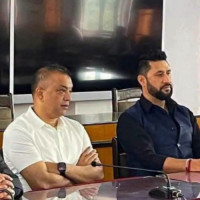
As the longstanding issue of usury remains unsettled, its victims chose to launch a march from Janakpur to Kathmandu in order to draw the government’s attention towards it. Considering the severity of the problem, the government took the matter seriously, offering an olive branch for holding talks with the usury victims. Minister for Home Affairs Sudan Gurung held dialogue with the representatives of the loan shark victims in Nijgadh of Bara district. The two sides reached a nine-point agreement to resolve the problem. The protesters had stopped their ‘justice march’ temporarily to hold talks with the minister. Anyway, the meeting was fruitful for seeking a solution to the problem.
The government seems to be committed to dealing with this issue once and for all as it has recently endorsed the agreement signed with the usury victims. It is also notable that the government has decided to instantly invalidate fraudulent loan deeds and other documents related to usury cases. The government has also decided to implement all the reports concerning predatory lending prepared by various probe panels. If the reports are enforced effectively, the problem may be resolved.
Mediation
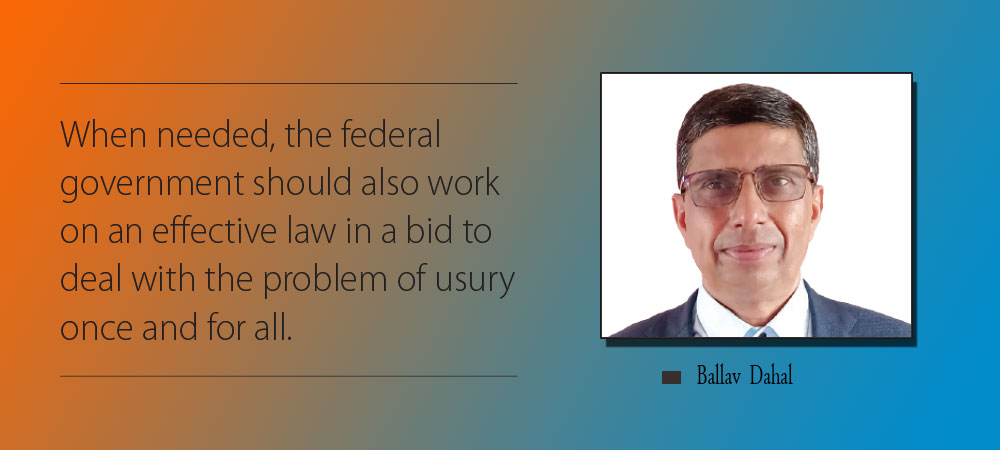
The government now considers unfair lending transactions as a criminal offense. District Administration Offices will use mediation teams to settle genuine claims and forward unsettled fraud cases to criminal courts. Local governments could play an important role in materialising the process of mediation. Being governments closest to people, their initiative could be instrumental in settling this problem. When needed, the federal government should also work on an effective law in a bid to deal with the problem of usury once and for all.
With the signing of this fresh agreement between the usury victims and the government, a new ray of hope has been created among the former. The main demands put up by usury victims included legal action against perpetrators (loan sharks), restitution of seized assets and sustainable measures to deal with the problem. There may be some genuine lenders among those who have been blamed for being dishonest.
So, all lenders must not be kept in the same basket. The activities of the accused should be investigated minutely once again before initiating any legal action against them. The government should also be wary of possible negative effects of the measures being taken on community harmony and trust.
(The author is a former deputy executive editor of this daily.)