- Wednesday, 29 July 2026

Integrating Industry Placements In Education
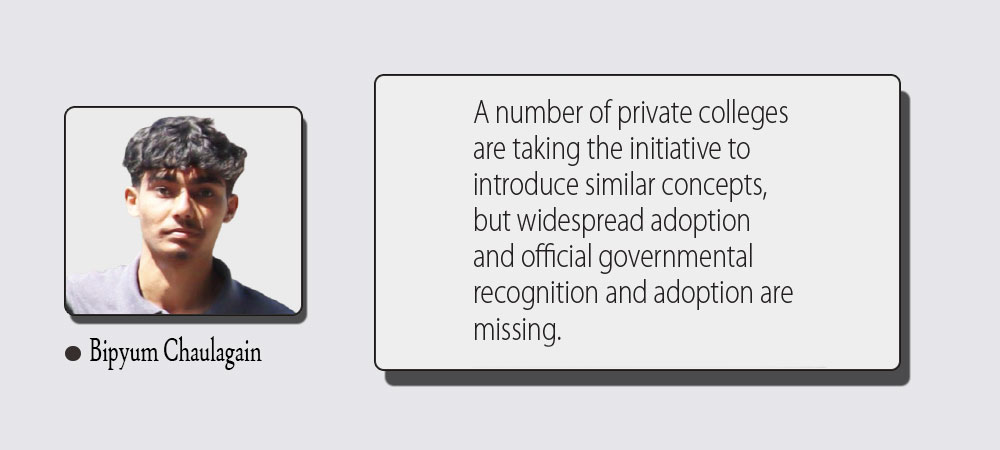

The Nepali educational curriculum for the post-secondary level has been the centre of active focus in educational and reform debates for the past years and has been trapped in a revolving loop of cosmetic reforms. Concerns that the present syllabus and curriculum does not meet the needs and demands of the current generation are widespread. And in response to these concerns, the present and the past governments have taken steps to address such concerns but have failed to satisfy the radical reform demands made by the public. Amidst these developments and concerns, one primary issue raised has been the lack of a structure in the educational system that provides job-relevant skills and, more than that, allows a direct pathway to a job.
While there are provisions for practical integration of work in programmes like social work and other community-focused humanities subjects, there is an evident lack of structure that provides a direct pathway for students from the classroom to the workforce. This is especially the case in technical degrees like engineering and IT. A direct pipeline to the Nepalese job market is missing in most degrees in the country. Cross-industry collaboration emerges as a crucial element in providing a solution to this issue. The central body for the regulation of education must promote collaborations between the job industry and educational institutions.
Curriculum-level changes
Beyond promoting or supporting such activity, there must also be policy-level and curriculum-level changes to accommodate radical changes in the educational sector so that the country becomes better suited to alluring the youth to pursue their further education and eventually their future in Nepal. Here the Nepali educational system can take a page out of the UK’s educational system’s playbook. Both postgraduate and undergraduate degrees in the UK feature placement year options, which the student can choose to get involved in, offering a direct pipeline to the real-world workplace environment.
Postgraduate degrees in the UK are of 1 year's duration, but students are offered the option to opt for a 2-year postgraduate degree that contains an additional year of practical experience. This model implies the active investment of the university or the colleges in securing job placements and in the future of the student after graduation, which Nepalese universities are missing in the present day. Having said that, a number of private colleges are taking the initiative to introduce similar concepts, but widespread adoption and official governmental recognition and adoption are missing.
Such practice is seen mostly in the UK-university-affiliated colleges that are making a radical attempt to modernise Nepal’s educational system. Recently the approval of the Foreign Academic Programme (Operation and Regulation) Regulations, 2083, has brought friction between the foreign university-affiliated colleges and the Nepali government. The approved rules and regulations are designed to regulate the practice of foreign university affiliation and ensure quality education. However, the enforcement of the regulations and their outcomes remain to be seen.
Beyond university-private sector collaboration, the idea of public service commission and university collaboration must also be considered by the government. There is an urgent need to re-engineer the public sector. Rather than isolating the Public Service Commission (PSC) as an isolated bureaucracy, the government must create a direct fast track for students of high excellence. It could be in the form of allocating direct governmental posts for gold medallists of certain subject categories or just allowing such students a bit of an advantage in the form of additional points in the overall PSC examinations.
Youth exodus
In the present day, multiple changes and efforts are being made by the government to make public service more lucrative to Nepali graduates. But wider macro- and microeconomic factors along with the lack of confidence in the educational system stand as possible deterrents to governmental service for graduates. And amidst the present youth exodus, questions about why youths are leaving should not be the only questions asked by the relevant authorities. Rather, self-questioning and regular checks and balances must be conducted between relevant educational bodies like universities, the Curriculum Development Centre (CDC), and the Ministry of Education.
Furthermore, the idea of providing incentives to graduates who choose to continue their future in Nepal must be explored in greater detail. While the idea of a large number of graduates continuing their future in their home country appears as common sense, it is actually the opposite and more troublesome when the youth exodus is taken into account. So while viable solutions are yet to be found, the recognition for solutions does appear urgent.
(Chaulagain is a psychology student at St. Xavier's College, Kathmandu.)