- Wednesday, 29 July 2026

Emerging Two Global Scenarios

As the United States and Iran exchange salvos for control of the Strait of Hormuz, two unprecedented scenarios appear to be unfolding on the global geopolitical landscape. One is the possibility of Iran emerging as a dominant regional power, compelling the USA and Israel to accept a deal that establishes it as a fourth global power, as predicted by Robert Pape, a Political Science Professor at the University of Chicago. The other possibility is the decisive victory for the USA-Israel alliance, paving the way for a new colonial order shaped by the neo-conservative leadership of the United States.
In a recent talk show programme organised by @Democracy Now, Professor Robert Pape said that Iran and the USA have caught themselves in an escalation trap which is leading them to increasingly more violent confrontation without any way out in the near future. According to him, an escalation trap in a war context means a situation in which a military power is compelled to strike enemy targets repeatedly and with higher intensity because these attacks are not achieving the set objectives, increasing the risk of defeat. According to Professor Pape, Iran is using its unique geographic formation and advanced weapon systems to render enemy air strikes ineffective.
Unprecedented edge
During the 145-day-long war, Iran has not only demonstrated an unprecedented edge in the use of sophisticated weapons, but it has also shown a strong capacity for selective blockade of the Strait of Hormuz. This has provided this country with unprecedented leverage to bring the global economic system to a standstill. Iran has maintained its escalation dominance in the Strait of Hormuz with the use of precision drone and fast boat technology to harm the cargo ships of unfriendly countries, providing the right of passage only to the ships belonging to its allies or to those states which commit not to support, help or participate in the war against Iran.
During the past weeks, the cargo ships of India, France and China are said to have crossed the Strait of Hormuz but not without the commitment to neutrality in the war. This shows that Iran has succeeded in achieving compliance with the threat of using force against anyone who defies restrictions. A recent event of a Kuwaiti cargo ship coming under Iranian fire has sent a stark message that Iran has the power and wherewithal to take punitive action as and when its authority over the Strait of Hormuz is challenged.
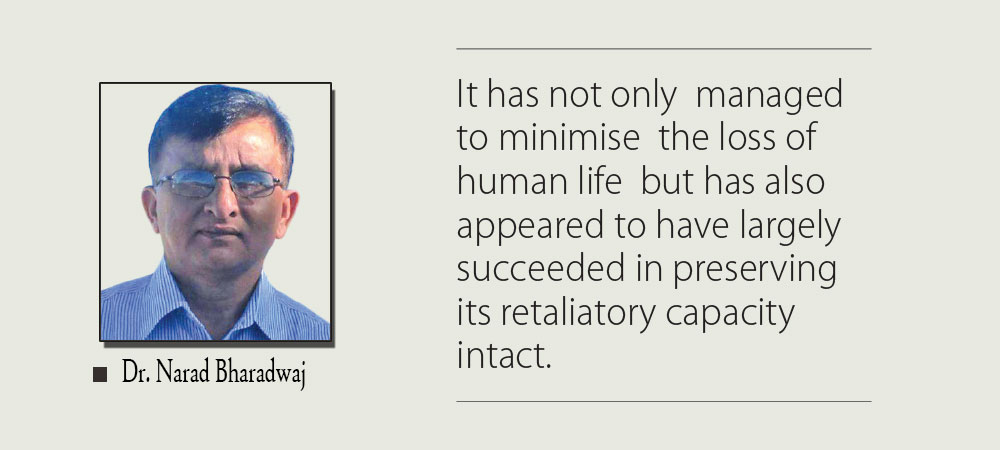
Iran has demonstrated unprecedented resilience. It has not only managed to minimise the loss of human life but has also appeared to have largely succeeded in preserving its retaliatory capacity intact by hiding vital and strategic war equipment deep underground. The bunker-buster bombs and other heavy ordnance do not appear to have significantly degraded Iran's military capacity. In the words of one US Army former colonel and Iraq war veteran, Douglas Macgregor, these strikes have acted a little more than a "sledgehammer hitting the Rock of Gibraltar". Renowned international analysts say that instead of exploring a modus vivendi, the USA has gone too far in pursuing hostility with Iran — a stance they contend will serve the interest of Israel rather than the American people.
Refusing to give Iran a softer deal and continuously threatening it with total obliteration, it risks goading the Islamic country to accelerate its nuclear weapons programme. Experts warn this is a highly likely scenario given the news reports that the stockpile of enriched uranium is still safe in the underground vaults deep inside rugged mountains, even after American strikes on Fordow, Natanz and Isfahan nuclear centers. On the sideline of expanding war games in West Asia, a discourse on the potential reversal of decolonisation has also started to reverberate in the boardroom of international politics. After World War II, the collapse of British and Japanese empires and the weakening of other European powers had triggered a wave of decolonisation. Scores of countries in Asia, Africa and Latin America won back their independence. Since 1974, the "third wave" of democracy swept away authoritarian regimes across the world, establishing democratic governance.
Unipolar world order
In 1991, the collapse of the Soviet Union gave rise to the emergence of a unipolar world order under the domination of the USA. Critics view that the traditional colonial era had ended but the former imperial powers simply shifted to other forms of dominance — utilising military alliance, UN agencies, INGOs and other western led financial institutions. In recent years, the USA and its ally Israel are openly calling for a reversal of decolonisation. With the rise of Donald Trump to power, he has said umpteenth times that he wants to bring Canada, Greenland, Venezuela and other South American countries under its control. The present-day war between the USA, Iran and Israel is viewed by geopolitical analysts as a manifestation of colonial expansion.
Finally, it will be interesting to end this piece with a paraphrase from a formal speech of American Secretary of State Marco Rubio at the Munich Security Conference held last February. He said, for five centuries before the end of World War II, the West was expanding. Its missionaries and explorers had crossed oceans, set up continents and built vast empires. But after 1945, it was contracting because of "godless communists" and "colonial uprisings ". He was nostalgic about the colonial era and called for its restoration. The global tension which his remarks represent frames the ideological binary of imperial domination and multipolar nationalism locked in a final battle. Who will win will decide the future course of human history.
(Dr. Bharadwaj is a former ambassador and former chairperson of Gorkhapatra Corporation. bharadwajnarad@gmail.com.)