- Wednesday, 29 July 2026

Improvement In Public Service Delivery
If you hear the conversations among common people these days, you can find they devote a substantial amount of time talking about current politics and related issues. They reflect on the general election of March 5, 2026 and express skepticism about their decision to cast a vote for the Rastriya Swatantra Party (RSP). They have not forgotten the promises that the RSP leaders made before the election. Along with many other promises, they mainly had convinced people to track down the corrupt politicians from different parties and bring all the money they had deposited in foreign banks back to the nation if they won. According to them, this money was enough to rebuild Nepal prosperously. During those days, the public had put all their hope on the RSP because they were fed up with all other political parties. As a result, this party won the election enthusiastically and formed the government.
Immediately after its formation, the government started to work tirelessly in the different sectors to bring positive changes but things did not turn out as expected by the country people. So, they are about to lose their hope and have started to complain, "It does not matter which party wins; our problems will always remain unaddressed." Their hopelessness has primarily been fueled by an array of fake news posted on social media.
Significant achievements
Obviously, the government has made significant achievements in several fields. For instance, there is a massive administrative reform, promotion of good governance, control of corruption, legal reform, and improvement in public service delivery and implementation of many initiatives to develop the economic sector. But unfortunately, the common people have not experienced any clear effect of such changes in their everyday life. However, there is one thing from which they are directly benefiting and it is the improved public service delivery. In the past it would take several days just to get your citizenship, for example, and you needed to take help from middlemen for this simple task. These days this is not the case; you can directly contact the government officers and get your job done within a couple of hours.
These days, the most talked-about issues in the country have been the 3 per cent equity tax on private education and health services imposed by the government. Thankfully, this tax has recently been removed after facing a widespread public debate and criticism. The people have considered this decision a positive gesture shown by the government. It also has an implication that the government always welcomes constructive feedback.
What was mismatched between the equity tax and private education and health services was that these services are not utilised only by the well-to-do families as the government had expected. Once I heard the Finance Minister, Dr. Swarnim Wagle, saying that for the parents who pay Rs. 10,000 monthly fees for their children's education, paying just Rs. 10,300 will not be a burden because the monthly increment is just Rs. 300. From his perspective, he may be true but there are many parents out there whose monthly income is Rs. 10,000 and they also send their children to a private school. For such parents, adding an extra 3 per cent for their children's monthly tuition fees would be huge. The same applies to private health services as well.
Another aspect for which the general public is disappointed is the government's decision to limit health insurance only to the government hospitals. We are pretty aware of the fact that the government hospitals are always overcrowded. Even if you have a minor health problem, you need to sacrifice the whole day to get checked up in a government hospital, which is quite painful. I have a couple of unpleasant experiences related to health insurance. First of all, I have found that hospitals treat differently the people who are insured and who are not. The staff members show interest to serve them first who pay money and the insured ones feel ignored. I have also seen many people who frequently visit the hospital in normal health conditions as well. Their reason behind this is simply to utilise Rs. 1, 00,000 - the amount covered by their yearly insurance premium of Rs.3, 500.
Misconception
It is a misconception among people that they think they are entitled to spend Rs. 1, 00,000 when they pay Rs. 3,500 as their health insurance. This is one of the reasons why the government is at a massive loss. And spending the money this way is not the purpose of health insurance at all. So, first of all, people must be well informed regarding the need for health insurance. The diseases must also be categorised which can be covered by the insurance and which cannot be or if covered, how much. Clearly, health insurance is a must for all citizens to protect them from unexpected and high medical costs. Therefore, it must be reviewed and implemented more effectively in the future.
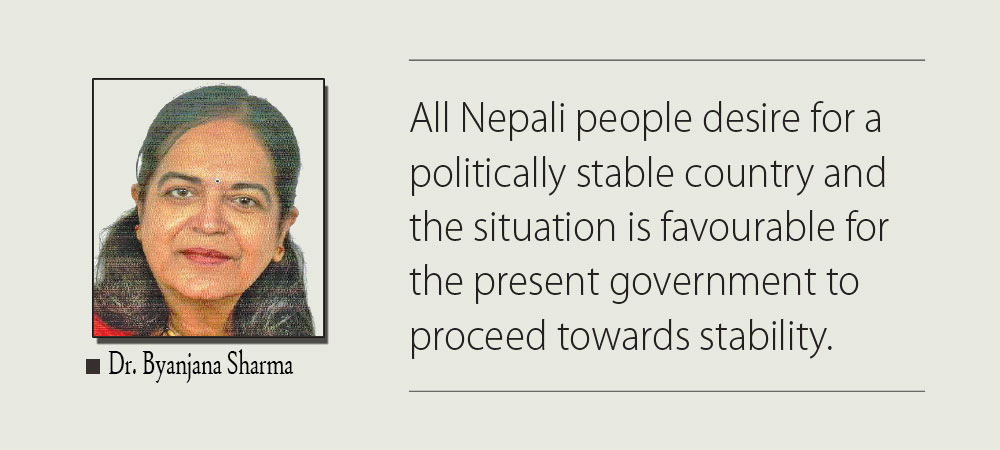
The government has started to reform many things at the same time, so it has been very difficult to see obvious changes to meet people's expectations. It is not wise of us to criticize every decision that the government makes. All Nepali people desire for a politically stable country and the situation is favourable for the present government to proceed towards stability. If things turn out positively, the government will also be able to bring all the money from the corrupt people back to the country. After all, who knows the future?
(The author is the director of Vidya Shilpa Academy, Damak, Jhapa.)