- Wednesday, 29 July 2026

Jaleshwar customs fails to meet revenue target
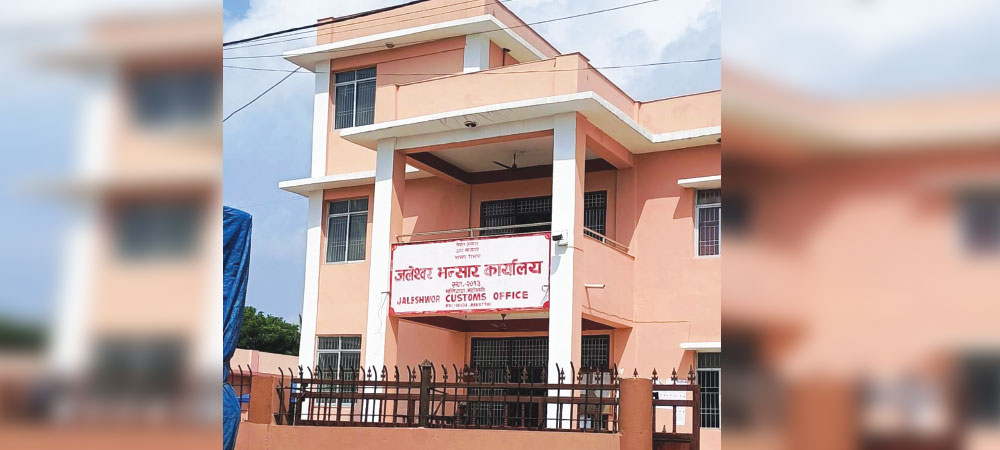

By Rabindra Upreti, Bardibas, July 23: Once recognised for collecting 182 per cent of its revenue target, the Jaleshwar Customs Office (JCO) has witnessed a steady decline in revenue collection over the past four fiscal years.
Officials attribute the downturn primarily to the suspension of petroleum imports through the customs point, the abolition of advance agricultural tax and changes in the import structure.
Revenue data from the past five fiscal years show that the gap between the office's assigned target and actual collection has continued to widen. Even after the Ministry of Finance (MoF) lowered the revenue target, the office failed to meet it, raising concerns over its performance.
In the fiscal year 2021/22, the MoF had set a revenue target of Rs. 1.70 billion for the JCO. The office exceeded expectations by collecting Rs. 3.09 billion, 182 per cent above the target.
However, revenue collection has declined steadily since then.
In the fiscal year 2022/23, the office was assigned a target of Rs. 3.64 billion but collected only Rs. 2.82 billion, around 22 per cent below the target.
Likewise, in fiscal year 2023/24, the target was Rs. 3.76 billion, while actual collection was Rs. 3.26 billion. Officials cited the Indian general election as one of the main reasons for the shortfall that year.
The situation worsened in the fiscal year 2024/25, when the office collected only Rs. 2.70 billion against a target of Rs. 4.54 billion, achieving just 59.47 per cent of the target.
In response to the continued decline, the MoF reduced the revenue target for the fiscal year 2025/26 to about Rs. 3.26 billion. Even so, the office managed to collect only Rs. 1.65 billion, or 50.55 per cent of the target, according to Customs Officer Bharat Adhikari.
Chief Customs Officer Rajendra Basnet said the biggest reason behind the decline was the halt in petroleum imports through the Jaleshwar Customs. According to him, petroleum products imported from India's Barauni Refinery previously accounted for 55 to 60 per cent of the office's total revenue.
"Revenue started declining after the Motihari–Amlekhgunj petroleum pipeline came into operation. Initially, only diesel was imported through the pipeline, so the impact was limited. Since petrol also began being imported through the pipeline in mid-February 2025, petroleum imports through Jaleshwar Customs have virtually stopped, leading to a sharp fall in revenue collection," Basnet said.
He added that the abolition of advance agricultural tax from the fiscal year 2025/26 had further reduced revenue.
At present, the customs office mainly handles imports of paddy, potatoes, sugar, spices, coal, onions, rice, fruits and green vegetables.
Adhikari said these commodities generate far less revenue than petroleum products. Refined edible oil and veneer are currently being exported to India through the customs point.
The customs office also noted that activities along the border significantly affect revenue collection. Protests, border disputes, elections, heavy rainfall, floods and strikes on the Indian side frequently disrupt cross-border trade, directly reducing customs revenue.
Traders say the Department of Customs continued to increase revenue targets in previous years despite a shrinking revenue base. They argue that although the target has now been lowered, continued failure to achieve it highlights the need to review the import structure, revenue sources and the target-setting mechanism.
They have urged the department to study the changing trade pattern at Jaleshwar Customs and set more realistic revenue targets in the future.