- Wednesday, 29 July 2026

Political Divide Threatens Democracy
Former British prime minister Winston Churchill had once mentioned that democracy is most probably the best political option available for humanity for peaceful and humane political organisation of society. Unlike dictatorship, democracy is highly valued and adopted for its responsiveness, openness and unencumbered space for dialogue, inclusion and accommodation. Basically, genuine democratic institutions are designed to negotiate and thrash out disagreements, channel conflict into peaceful contestation and reach agreements.
Political scientists hold the view that some measure of ideological differentiation and partisan competition is not only unavoidable but also healthy in a democratic society. Sharp disagreements over social, economic and political issues or foreign policy reflect the existence of palpable differences within society. Democratic politics without meaningful and strong disagreement is said to be unrealistic and improbable. The debates, disagreements and criticisms directed at some of the so-called hasty decisions of the incumbent government in our country should be appreciated as the unavoidable occurrences in a democratic polity.
Evolving democracy
This is not the case of an evolving democracy like Nepal alone. The mature and developed democratic countries like the United States, Britain, Germany and France are no better than Nepal. These countries have reportedly deteriorated into a kind of polarised societies. The disagreements and disputes over issues like race, gender, immigrants, employment, and citizenship have resulted in social unrest, discord, and disharmony. However, thanks to the vibrancy of democratic institutions in these countries, bipartisan cooperation has been made possible, which offers spaces to negotiate, dialogue, and sort out differences.
Be that as it may, the democratic institutions in these countries are also found overstressed and overstretched to offer and convene spaces to resolve discords and disagreements. Take the case of the US today under President Trump. The excluded groups like Blacks and Hispanics begin making claims for equal citizenship, representation, and political power. The disagreements over who properly belongs within the polity are becoming sharper and socially consequential. Modern democratic politics is not merely a matter of aggregating preferences. It also raises fundamental questions about collective identity, membership, and power that lead society to affective polarisation.
In a widely read article published in the Journal of Democracy recently, Shanto Iyengar and his collaborators define “affective” polarisation as the tendency of political partisans to dislike and distrust one another as social groups rather than merely to disagree over policy. Under conditions of affective polarisation, political identity increasingly functions less as a set of policy preferences and more as an emotionally charged social identity. According to political scientists, affective polarisation is not the same as ethnic conflict, but it shares some similarities. Affectively polarised groups behave as if they were ethnic communities of mutual disdain.
Indeed, it is no accident that democratic polarisation becomes especially dangerous when identities become socially fused with racial, religious, or ethno-national divisions. Opponents increasingly appear as hostile communal enemies rather than ordinary political rivals. This distinction between ideological and affective polarisation is critical because pogroms, lynchings, and communal riots rarely emerge from ordinary policy disagreement alone. They emerge when political conflict becomes emotional, moralised, and existential. The affective polarisation shifts attention away from ideological distance and toward the emotional foundations of democratic conflict. Recent work by Nicolas Campos and Christopher Federico makes this point even more explicit by emphasising processes of “othering,” “aversion,” and “moralisation.”
Political opponents increasingly appear not only different but alien and illegitimate. Politics, under these conditions, ceases to involve competition among fellow citizens and instead becomes a struggle among hostile moral communities. Yet even affective polarisation does not automatically produce violence. Moreover, almost all political research on the relationship between affective polarisation and political violence measures “approval” or “support” for violence—that is, attitudes toward violence—rather than actual violence itself. Most polarised societies do not descend automatically into communal bloodshed.
Political scientists opine that the problem is not polarisation alone but the conditions under which polarisation becomes fused with institutional weakness, demographic anxiety, and fears about the ownership of the polity itself. Available evidence tends to suggest that even lower levels of political violence can reshape democratic participation long before societies slide into open communal conflict. Threats and intimidation result in the withdrawal of public servants and other state stakeholders from political life, particularly women, minorities, and younger officials coming from vulnerable segments of society.
Democratic competition
Communal violence is strongly tied to democratic competition and state behaviour. Riots become more likely when political elites see electoral incentives to tolerate or encourage anti-minority violence, particularly where minorities are locally weak and politically expendable. By design, when the state fails to intervene to prevent violence, inter-communal harmony and positive relationships turn out to be very important in restraining violence even amid high levels of polarisation. Communal violence becomes especially dangerous when religious identity becomes fused with electoral competition and struggles over political control. Under such conditions, polarisation becomes simultaneously political and affective.
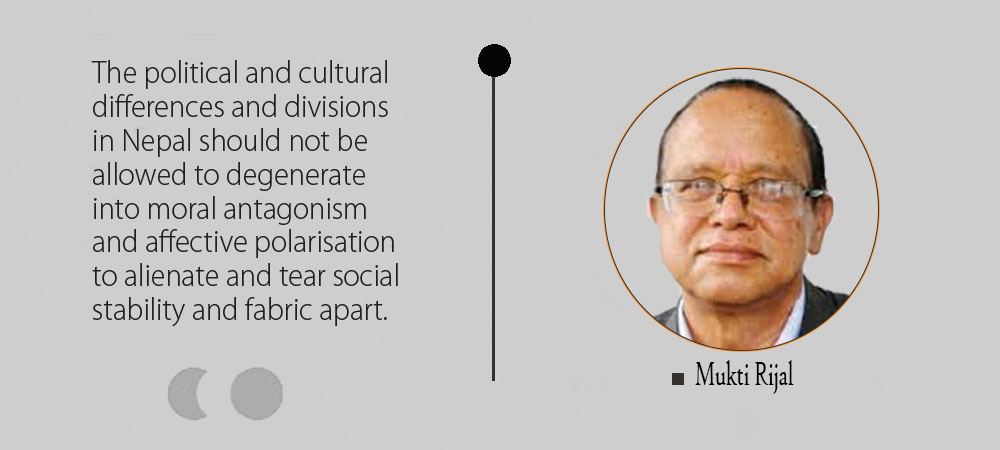
In India’s case, Hindus and Muslims increasingly appear not simply as competing electoral constituencies but as morally antagonistic communities whose political conflict threatens the social fabric and amity. Nepal has been a multicultural society characterised by religious and linguistic diversity and spatial heterogeneity. This plurality can be an asset for social stability, positive peace and harmony if properly accommodated and included in the democratic body politic of the country. Ethno-political mobilisation spearheaded to serve vested political interests can be an anathema to social peace and harmony. The political and cultural differences and divisions in Nepal should not be allowed to degenerate into moral antagonism and affective polarisation to alienate and tear social stability and fabric apart.
(The author is presently associated with Policy Research Institute (PRI) as a senior research fellow. rijalmukti@gmail.com)