- Wednesday, 29 July 2026

Rationale Behind University Establishment

We often talk about the need for university establishment and its operation without reaching a logical conclusion. While some argue that the apex administration should be appointed by a board of trustees, which they claim is free from political interference, others say that the existing provisions are right. The appointments made so far have not yet undergone a significant breakthrough. Even in the recent move, VCs for seven different universities have been appointed in accordance with conventional rules and practices. There are allegations that the same political practice has been repeated, yielding no new results in university operation practices.
Despite having little knowledge of what many aspirants for VC positions in Nepal presented to the selection teams of eight universities recently, we can infer that they expressed deep concern about the deteriorating physical condition and declining quality over the years. Undoubtedly, they suggested significant measures to rectify the current situation and make our universities true educational hubs in this region. Not denying whatever they suggested, I would like to add a few more, some of which I conjecture they missed discussing. They can be classified into geographic categories. Likewise, they can be categorised by the theme they cover.
Physical Restructuring
Presently, there are at least a dozen universities run directly by the federal government throughout the state. Among them, seven seem to represent the provinces where they are situated. We have been operating Purvanchal University in Koshi, Rajarshi Janak University in Madhes, Tribhuvan University in Bagmati, Pokhara University in Gandaki, Buddhist University in Lumbini, Madhyapaschim University in Karnali, and Sudurpaschim University in the province of the same name. In addition to these universities, others have been opened, apparently repeating the same pattern. They now represent each region in the provincial geography, but that was not the case at their inception, as the state's national administrative division was different then. I do not mean they should represent only their respective provinces; indeed, they should be national universities with equal resources and opportunities. They should run all possible programmes, ranging from general to specialised courses across all disciplines.
So far, we have been running these universities without any substantial rationale except Tribhuvan University. Yet, despite being the oldest in the country and one of the largest in the region, even TU has not been able to become a higher education institution that can meet the needs of the maximum number of students who want to become competent graduates capable of competing in the global market.
I would argue that even the names of the universities could be changed to reflect geography rather than historical figures such as Tribhuvan, sages like Rajarshi Janak, or other prominent people such as Madan Bhandari, except in cases where they have significantly contributed to both quality education and remarkable endowments. If this happens, the names of the universities might be Koshi University, Madhes University, Bagmati University, Gandaki University, Lumbini University, Karnali University, and Sudur Paschim University. But I am sure there will be vehement objections about renaming, as they have already gained a reputation with their present names. I doubt whether they are really reputed for quality education, despite being indelible in the minds of millions, and choosing one while leaving the other aside, with the fallacious assumption that what they have chosen is better than the other.
There is nothing in the name that impels us to stick to that indeed, as Shakespeare long ago said in his famous play Romeo and Juliet (1597), “What’s in a name? That which we call a rose by any other name would smell as sweet.” There might be a quick retort from some people that they are historic names and are inscribed in statutes, so they are unchangeable. But they may fail to justify their claim with adequate evidence. If we change names geographically, they can be justifiable for clarity and convenience. A name that lasts for ages and ages should be chosen with the wise decision of people in general consensus, and it can also catch on in people’s tongues. They can be administratively convenient and easy from a management perspective.
Thematic Restructuring
Apart from multidisciplinary universities, even national universities are organised around a theme. Some examples are Sanskrit University in Dang, the Buddhist University in Butwal, and Yogmaya Ayurved University in Arun Valley.
A university can be contributory and credible only if it updates its curriculum, pedagogy, and research, the three pillars of a contemporary higher education institution. For such things to happen, a university should focus on a particular theme despite other areas running alongside. Even the highest-ranking universities worldwide cannot offer all subjects and fields due to financial constraints and a shortage of qualified personnel. But whatever they do with what they have, they can excel at producing competent graduates.
Each province can establish its own provincial university using available resources and energy. They may not offer all programmes for all subjects, as they are currently practicing. Their programmes should be tailored to provincial needs. By doing so, we can ensure effective administration and management and also save a large amount of money for quality improvement. However, national or provincial universities have been established and are being established without a clear vision or goals in large numbers. That has created not only an additional financial burden but also energy waste.
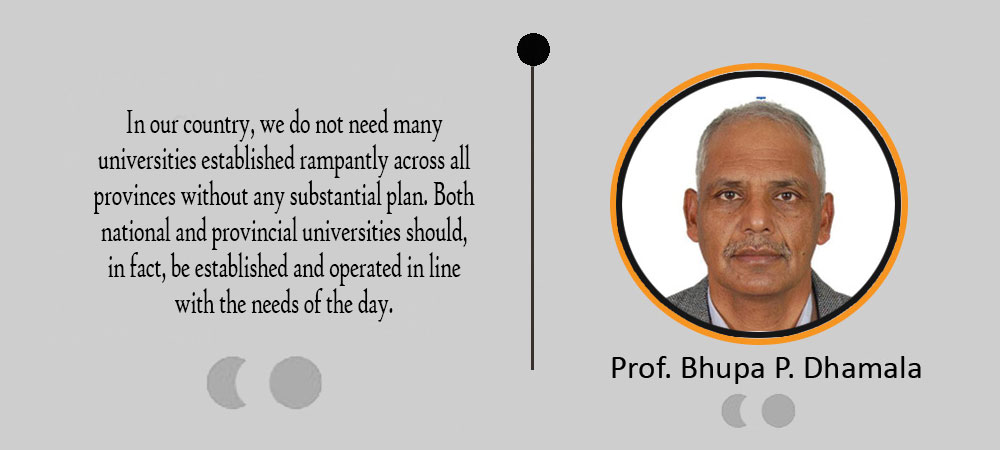
In our country, we do not need many universities established rampantly across all provinces without any substantial plan. Both national and provincial universities should, in fact, be established and operated in line with the needs of the day. Therefore, we must have a rationale for establishing and operating any new university by the federal state or the regional province. National universities should be established based on national needs, and provincial universities can be established to meet the needs of the region's people. One such rationale is the quality of higher education.
(The author is the chairman of Molung Foundation. bhupadhamala@gmail.com.)