- Wednesday, 29 July 2026

Screens Unite Local Communities

It’s 1 pm on a July Saturday and brothers Ghanashyam and Ghananath Phaiju are in a rush to reach Lagan, Kathmandu. They heard from their uncle last night that some people were going to screen a free movie there.
They didn’t catch the time, they didn’t enquire who the movie starred in, they didn’t even ask what the movie was about. They just heard the word ‘filim,’ as their uncle pronounced it, and decided they needed to watch it.
It was a little before 10 am when the siblings, 13 and 11 respectively, set off from their home – on foot – at Sirutar, Bhaktapur. That means, the brothers have been walking for over three hours. But they’re not tired. In fact, they’re more energetic than ever now that they have Lagan in their sights.
They see a large white cloth draped across the outer walls of several houses – a makeshift screen to project the movie on to. And …
“That’s the last memory I have of that day,” Ghananath chuckled as he recounted that day 60 years ago with this ink-slinger on 27 June. “I don’t remember how long the movie was, what, or if, we ate anything during, or when we returned home.”
“The movie was never the attraction at all. It was the desire to get out of our homes and immerse ourselves in the communal vibrancy that the free screening seemed to promise our young minds,” the now 71-year-old continued.
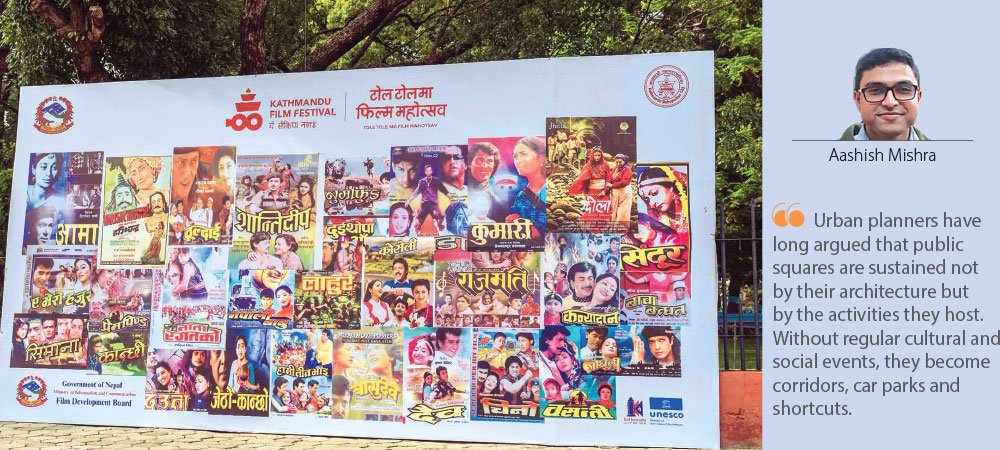
This month, a Facebook post made that promise again. ‘Tole Tole Ma Film Mahotsav’ (Film Festival in Every Neighbourhood), it read. Location Sundhara, free entry, he did not need to know anything else.
The Sundhara iteration of the festival was held under the new Dharahara on 27 June, Saturday. Ghananath was there with his grandson, and it was there that he spoke with this writer. Once again, the actual films, the organisers, the stars, were all secondary to him. “It’s the atmosphere.”
“Tell whoever organised this to keep going, and expand to other locations in Kathmandu Valley. Our courtyards, crossroads, Bahals, Bahis, Lachhis and Chowks were meant for events like this that bring people together,” he requested in this publication.
“We need an excuse to meet people, to enjoy with family and friends, to, you know, live as the social beings we used to be.”
Ghananath would be happy to know that the film festival is indeed being held across multiple locations. It began at Khulla Manch on 19 June and will conclude at Yetkha on 11 July. During this period, it reached people at Bagbazaar, Sundhara, Maitidevi, Balaju – and Lagan too.
Kathmandu Metropolitan City (KMC) has managed the overall technical aspects of the programme while local organisations, including Echoes in the Valley, Neelah Cultural Club, Nirnaya Nepal, Luja: Newa: Sanskritik Pucha:, Maitidevi United Club, Nhugu Pala Sanskritik Misa Pucha:, Yenka Pucha: and Nepal Bhasa Syene Kane Foundation, were selected through an open call to manage the individual iterations of the film festival in their areas.
At Lagan, the festival was held on 4 July. This scribe couldn’t make it because it rained, but he went the next day and asked around. According to the local shopkeepers, the rainfall did not dampen spirits at all.
“It scattered the people but many of them did not go home,” storeowner Medhavi Shrestha said. “It was just like old times.”
The old times she speaks of are, in her own words, the days before smartphones and before out-migration. Children would gather at Lagan Chowk to play a variety of games, while adults stepped outside to catch up with neighbours and unwind after long days. These public spaces were more than just places to pass the time; they were where the community came together and forged a sense of belonging.
Then, gradually, the children grew up and moved away. The adults grew old and stopped coming out. Lagan itself was never empty, but it lost the spirit that had once defined it. The laughter, conversations and neighbourly warmth that filled the square gave way to the hurried indifference of passers-by and motorists who only saw it as a parking lot.
"I have never seen Lagan empty, except during the COVID-19 lockdown, but yesterday was the first time in a long time that I saw it truly alive," remarked Paan Kumari Adhikari, another local shopkeeper.
In a press release issued before the first screening at Khulla Manch, Kathmandu Metropolitan City stated that the festival intended to contribute to the development and expansion of the Nepali film industry by establishing a connection with the community. Perhaps that is why it did not ask people to travel to a cinema hall or a covered hall.
Instead, it brought cinema to the places where people once gathered as a matter of habit. And in doing that, it turned the films into a tool for the reclamation of public spaces that had slowly surrendered to the crushing sterility of modernity.
At this point, your scribe feels it necessary to stress that this piece is not a news report. This is not an objective account of facts prepared after talking to all sides. Quite noticeably, he hasn’t quoted the main organiser, the KMC, nor has he presented the viewpoints of the artists whose films have been exhibited.
This piece is merely an observation made by a man who feels that ‘Tole Tole Ma Film Mahotsav’ is an entity bigger than the sum of its parts. Through the films it screened – the writer apologises for not naming any of them – it gave a glimpse into what neighbourhoods can still be when they are given a reason to fill with people rather than cars, stalls or construction materials.
Urban planners have long argued that public squares are sustained not by their architecture but by the activities they host. Without regular cultural and social events, they become corridors, car parks and shortcuts. A film festival cannot reverse decades of social change, but for a few evenings, it showed everyone what the soul of a city was.
(Mishra is a storyteller, cultural enthusiast and communication professional.)