- Wednesday, 29 July 2026

El Niño likely to delay monsoon further
Kathmandu, June 17: The season for paddy transplantation has begun across the country and farmers are eagerly awaiting the rainfall that accompanies the monsoon. However, the monsoon, which normally arrives around 13 June, is already three days overdue this year. Meteorologists said its arrival could be delayed by few more days this year due to the influence of developing El Niño conditions.
Rojan Lamichhane, a meteorologist at the Meteorological Forecasting Division under the Department of Hydrology and Meteorology (DHM), said this year's monsoon appears likely to arrive later than usual.
However, he said that pre-monsoon activity has become more active and atmospheric conditions are gradually becoming favourable for the monsoon. “As a result, isolated rainfall is already occurring in the hilly regions of Koshi, Bagmati and Gandaki provinces, as well as in parts of the Tarai of Madhesh and Lumbini provinces. Some areas are receiving light rainfall, while others are experiencing moderate showers.”
“This is not the first time the monsoon has arrived late. In previous decades, it has entered Nepal around 21 to 24 June in some years. This year, too, it appears likely to arrive later.”
According to DHM, previous El Niño years also caused delayed arrivals, with the monsoon setting in on June 18 (1972), June 27 (1982), June 24 (1987), June 14 (1992), June 21 (1997), June 14 (2002), June 15 (2009), June 23 (2015), June 15 (2019), and June 20 (2023).
When asked whether the monsoon could be delayed by another week, he said it was too early to make a definitive prediction. “We are still analysing the situation. We need to assess how various atmospheric factors and monsoon criteria are evolving before making a firm announcement. The public should have a clearer picture within the next few days.”
On the link between El Niño and delayed monsoons, Lamichhane said further study is needed, but historical records show that some years with El Niño conditions have also experienced delayed monsoon onset.
He explained that El Niño is gradually developing and is expected to strengthen in the coming months. As it becomes stronger, it could influence the monsoon system over Nepal and other parts of South Asia.
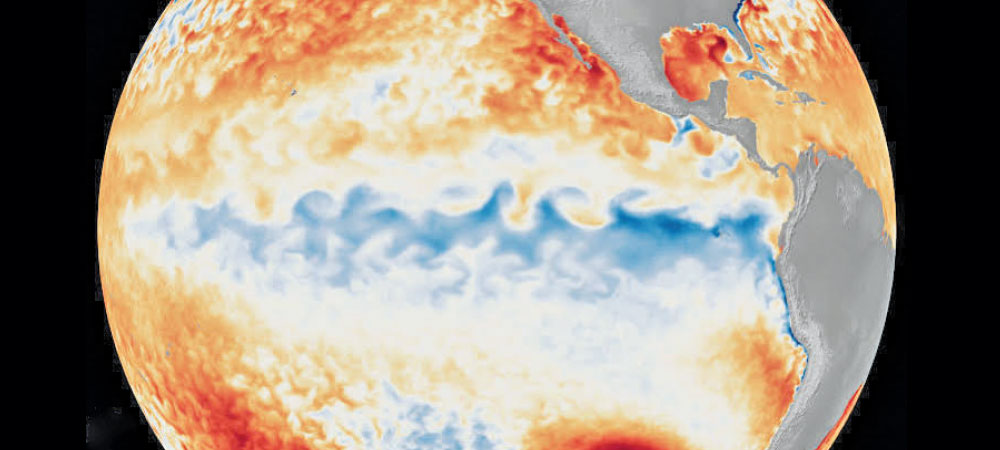
An El Niño phenomenon has already developed in the Pacific Ocean and is currently strengthening. Consequently, this is expected to impact the onset of Nepal's monsoon and there is a possibility that the monsoon could be weaker across South Asia, including Nepal. In past years as well, the onset of monsoon was delayed due to the influence of El Niño.
What is El Niño
Lamichhane said El Niño refers to unusually warm sea-surface temperatures in the central and eastern Pacific Ocean. These warmer waters influence atmospheric pressure patterns. During El Niño years, low-pressure systems tend to develop over the eastern and central Pacific, while relatively higher pressure develops over the western Pacific.
He said these changes can alter global weather patterns, including the South Asian monsoon.
“The monsoon that reaches Nepal generally travels through the Bay of Bengal. El Niño can weaken some of the atmospheric support systems that help bring moisture and rainfall into the region, which may reduce rainfall or delay monsoon activity to some extent.”
Adhikari added that Nepal is not currently experiencing a strong El Niño event but that climate models indicate a gradual movement towards El Niño conditions. “At present, conditions are moving gradually from a neutral phase towards El Niño. Global climate analyses suggest that El Niño could strengthen further in the coming months.”
When asked about a “super El Niño”, he explained that it refers to an exceptionally strong El Niño event.
“There are different categories of El Niño -- weak, moderate and strong -- based on ocean temperature anomalies. A ‘super El Niño’ refers to a very strong event. However, monsoon behaviour cannot be attributed to El Niño alone, as many other atmospheric and oceanic factors also influence rainfall patterns.”