- Wednesday, 29 July 2026

Two-day holiday a boon for Nepal’s tourism industry

Kathmandu, June 14: The introduction of two-day weekly holiday has significantly boosted domestic tourism across Nepal, resulting in a sharp rise in hotel occupancy and economic activity in major tourist destinations.
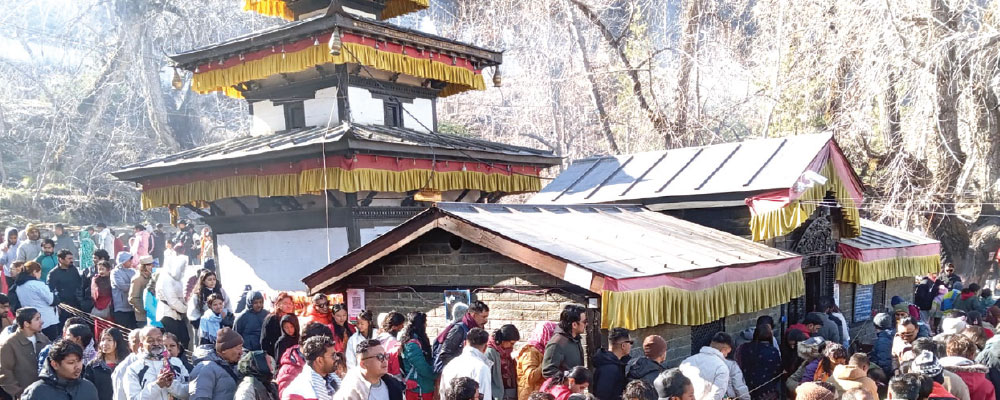
Popular destinations such as Mustang, Pokhara, Chitwan, Dhulikhel, Nagarkot, Bandipur, Manang, and Sailung witnessed a surge in domestic travellers as families and groups took advantage of the extended weekend for short vacations.
The impact became particularly visible during the four-day holiday from May 28 to May 31, when tourist sites across the country experienced an overwhelming influx of visitors.
The government has decided to grant a public holiday on Sundays, effective from April 6, to help reduce fuel consumption and ensure smoother fuel supply management in the wake of West Asian conflict. Hotels in several tourist areas reported high occupancy, with many establishments reaching full capacity.
Tourism entrepreneurs said increased visitor movement has helped revive businesses dependent on seasonal and weekend travel.
They said the two-day holiday policy, which initially seemed unusual, has proven effective in revitalising tourism businesses and strengthening local economies.
Binayak Shah, President of the Hotel Association Nepal (HAN), said the two-day holiday has brought positive momentum to Nepal’s tourism sector by encouraging families to travel more frequently, particularly in the post-COVID period when leisure travel has grown. “The recent four-day holiday saw a sharp rise in domestic tourist movement, with hotels in major destinations reaching full occupancy, making accommodation difficult to secure,” he said.
According to Shah, the holiday system has encouraged people from urban centres, especially the Kathmandu Valley, to travel farther and spend more on accommodation, transport, restaurants, and recreational activities.
Mani Raj Lamichhane, Director of the Nepal Tourism Board in Gandaki Province, said the two-day holiday has created a “synergy effect” in the tourism sector by allowing families and groups of friends to better manage travel and recreation.
In the past, weekend travel was mostly limited to nearby destinations. However, the two-day holiday has encouraged people to visit even distant places,” he said. Lamichhane said more than 30,000 domestic tourists visited Ghandruk during the four-day holiday period between May 28 and May 31, demonstrating how extended holidays can boost economic activity in rural areas.
He added that occupancy increased significantly across hotels, from small lodges to luxury properties, with rooms becoming difficult to find during peak travel days.
Rameshwar Shah, Chairman and Chief Executive of KTM Hospitality, said the two-day holiday has strengthened domestic tourism by enabling people to travel more frequently.
“When there was only one-day holiday on Saturday, people had to wait for longer breaks to travel.
Now, salaried employees can leave on Friday evening and return on Sunday, making even distant destinations more accessible,” said Shah, who is also chairman of Royal Tulip, Chitwan.
Boosting local economy and employment
According to HAN President Shah, the surge in domestic tourism has not only benefited the hospitality sector but also contributed positively to the broader economy.
Increased tourist movement has boosted local production, raised community-level income, and generated employment opportunities, he noted.
“With the growing tourist inflow, economic activities and tourism promotion have been rising in rural areas,” said Lamichhane.
Restaurants, local transport operators, souvenir shops, and small businesses have also benefited from the increased flow of tourists.
Hari Prasad Gaire, President of Hotel Association Nepal, Gandaki, believes that short public holidays have become increasingly important for promoting domestic tourism in Nepal. With the increasing tendency to travel, this not only supports the tourism sector but also contributes to the overall national economy. As expenses increase, government revenue from the tourism sector also increases, boosting the local economy and employment generation. With limited time and budget, many families prefer short trips within the country, creating economic opportunities in tourism-dependent areas.
“The increased tourist movement has also generated a multiplier effect in the economy. Higher hotel bookings create demand for local agricultural products, food supplies, transport services, and temporary employment. Local vendors, guides, and small entrepreneurs benefit from increased spending by visitors,” said HAN President Shah.
Concerns over policy sustainability
Despite the positive impact, entrepreneurs have raised concerns over the sustainability of the two-day holiday provision, stressing that continuity is essential for long-term domestic tourism growth.
Following the decline in foreign tourist arrivals during the COVID-19 period, the government introduced policies to encourage domestic travel, including tourism leave for employees.
Through the budget for fiscal year 2021/22, civil servants and employees of public enterprises and academies were granted 10 days of tourism leave along with an amount equivalent to 10 days’ remuneration to encourage travel within Nepal. The private sector was also encouraged to offer similar benefits.
However, tourism stakeholders said the policy failed to deliver expected results due to the absence of implementation guidelines.
HAN President Shah said the recent success of extended holidays shows that well-implemented and sustained measures can significantly boost tourism and the wider economy. He added that rising consumer spending, backed by salary increases and improving economic confidence, is also contributing to higher tourism expenditure.
Through the budget for fiscal year 2026/27, the government has announced a salary increase of up to 21 per cent for government employees, which is expected to influence remuneration in the private sector as well.The HAN President noted that hotel occupancy rates have now exceeded an average of 40 per cent, while Indian tourist arrivals have also shown notable growth.
However, he said accommodation shortages still occur during peak holiday periods in popular destinations.
According to Gaire, average hotel occupancy in Pokhara has reached around 45–50 per cent after the implementation of the two-day holiday, supported by a rise in Indian visitors.
The increase in Indian tourist arrivals in recent days has also contributed positively to the tourism sector, particularly in Pokhara, he added.
The number of people going out for family trips has increased after most schools in New Delhi, Haryana and Uttar Pradesh were closed due to extreme heat.
In such a situation, the number of people choosing Nepal as a suitable destination to escape the heat has increased.
Gaire added that hotels in Pokhara were nearly fully booked during consecutive holidays two weeks ago, with occupancy reaching as high as 90 per cent. “We expect the government to continue this holiday arrangement in the long run,” said entrepreneurs.
Need for long-term planning
Tourism entrepreneurs also welcomed the government’s plans to celebrate 2085 B.S. as Tourism Year and 2027 as Nepal Wellness Year, calling them positive initiatives for the sector.
Through the budget speech, the government announced physical and financial incentives for the construction and operation of high-value, tourist-oriented resorts and hotels. It has to brand tourism activities under the theme of “Wellness Tourism,” while efforts will continue to diversify tourist source markets.
However, HAN President Shah stressed the need for immediate preparation and stronger coordination among federal, provincial, and local governments, with active private-sector engagement to ensure success.
Referring to the rapid expansion of hotel infrastructure in recent years, he said the government should increase investment in roads and other infrastructure to improve access to tourist destinations. “Foreign tourists are no longer limited to Kathmandu, Lalitpur, and Pokhara. They are increasingly visiting remote areas to experience natural beauty and local cuisine, which boosts tourism spending,” he said.
He said this trend would help generate local employment and add momentum to the economy.
Nepal’s hospitality sector currently has the capacity to accommodate around five million tourists. “As recent government policies are positive, Nepal should target attracting five million tourists within the next five years. This is achievable if the government and tourism entrepreneurs jointly prepare a master plan,” he said.
Official statistics show that 1.15 million foreign tourists visited Nepal in 2025. By May 2026, Nepal had recorded 529,090 international visitor arrivals, while a large number of Indian tourists also entered via land borders.